

Before the coffee gets cold
— and the quiet entanglements we carry

When was the last time a book rearranged something subtle inside you—not with thunder, but with steam rising from a warm cup? Not with fireworks, but with a whisper that lingered just long enough to become a question.
I recently finished reading Before the Coffee Gets Cold by Toshikazu Kawaguchi. It left me hushed.
At the centre of the novel is a small café tucked away in Tokyo. A place with a strange, almost sacred rule: if you sit in a particular seat, time travel is possible. But only if you follow all the rules. You cannot get up. You cannot change what happens next. And—perhaps most tenderly—you must return to the present before your coffee gets cold.
This isn’t a story of do-overs. There are no second chances to rewrite the outcome. No saving the world, no grand gestures.
Only this: A moment. Revisited. Re-seen. Re-felt.
The rule—that you cannot change the present—becomes, paradoxically, the deepest invitation. A quiet rebellion against our reflex to fix, to explain, to resolve. What if the point was never to undo, but to understand? To shift the weight inside, not the facts outside?
It made me wonder: how much of our pain is from what happened—and how much from how tightly we continue to carry it?
So much of what I make, I realise now, comes from that same impulse. Not to chronicle, not to dramatise. But to sit with. To return to what once overwhelmed me—and hold it with a steadier hand. To give my past the presence it once lacked.
This feeling came alive most viscerally in Nested.
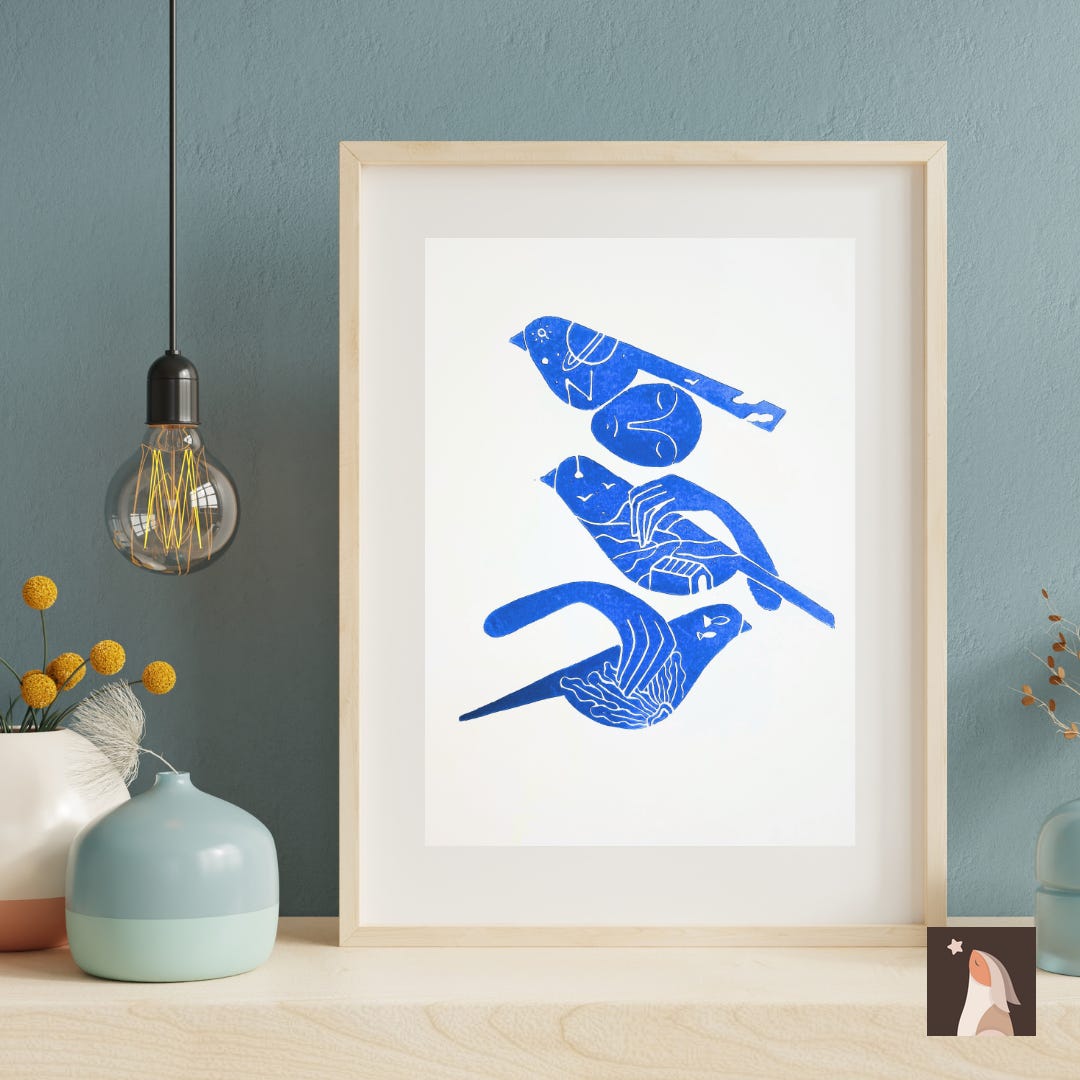
I didn’t set out to “say something” with the piece. I only knew I was tangled. That multiple feelings—grief, guilt, tenderness, exhaustion—were playing simultaneously inside me, like the sympathetic strings of a sitar. Not dissonant, but complex. All sounding out from one body. All trying to be heard.
The central figure in Nested appears calm at first glance. But linger, and you’ll see the threads. The unspoken. The over-explained. The conversations rehearsed but never had. The contradictions of mothering while unmothered. Of creating while drained. Of yearning for stillness while constantly in motion.
Isn’t that what the characters in Before the Coffee Gets Cold are doing, too?
They return to say the thing they couldn’t say. To apologise without hoping to erase. To witness someone else’s truth more clearly. The past doesn’t budge. The coffee still cools. But they leave changed. Not because the story rewrote itself—but because they finally showed up for it.
“…no matter what difficulties people face, they will always have the strength to overcome them. It just takes heart. And if the chair can change someone’s heart, it clearly has its purpose.”
~ Toshikazu Kawaguchi
That line slipped under my skin.
Because sometimes transformation isn’t thunderous—it’s subtle. Sometimes the heart overcomes not by pushing through, but by softening. By making room. For contradiction. For grace. For the parts of ourselves we’ve tried to disown.
That’s what Nested became for me: a quiet sculpture of surrender. Of threads allowed to coexist, not be resolved. A reminder that we’re not meant to be perfectly wound, only held.
And maybe, that’s the real magic of time travel—emotional or otherwise—it’s not that the story changes. It’s that we do.
We sit. We stay. We listen. And in that stillness, something returns. Like the café in the novel, art offers us a seat. We bring in our regrets, our clumsy goodbyes, our too-late recognitions.
And we leave—perhaps not lighter, but more whole.
We exit with the clarity that comes from having truly been there. From feeling time not as something to manage, but something to befriend.
The paradox is beautiful: the past remains untouched. But the relationship to it shifts. And in that quiet rearrangement, something in us softens.
If you’d like to own a limited-edition lino print of Nested—a piece born of this gentle entanglement—DM me here or on Instagram.
And maybe, while reading this, you were mid-cup. Mid-thought. Mid-regret. Mid-mending. Maybe something small stirred. If so, I invite you to sit with it, for just a little longer:
What moment calls you back—not to fix, but to feel? What would it mean to stay present, even if just for one sip more?
Because even if the past can’t be rewritten, your presence can. And before the coffee gets cold—you might find the story has already changed.
Was there a line or idea in the book that stayed with you too? Or a moment you’ve often wished you could return to—just to feel it again? I’d love to hear.
We’re all time travelers in the worst way. We revisit regrets more than memories.
If only, someone robbed us of our ability to conjure'If only' and 'what ifs' and we could hold one moment without hesitation and own it completely, it would be more sacred than a thousand rewinds of almost.
This is my TBR,now I definitely want to read it.